
Luke
Remembering The Goodest Boy
It was a bright October day in 2014. We had arrived at a puppy adoption event organized by Last Hope K9 Rescue. When it was time to meet the adoptable dogs, we were brought into a large room with maybe a dozen puppies running around for a meet and greet. My daughter’s attention was trained on an energetic pup with anxious energy, and started asking if we could bring that one home. Her mom and I weren’t so sure, as we didn’t want another high maintenance dog like our previous one. But then Seal casually ambled up to us, looked up, and—maybe with a little pop of his head—said “hey… what’s going on?”

Seal had a casual, easy-going energy. This pup was an old soul. After playing with him for a bit and a taking him for a walk, we were smitten. We signed the papers and Seal came home with us that day.
We figured that he had been named Seal because, well, he kind of looked like one. Especially with his ears flipped back. He even barked like one. Apparently, he had a sister named Heidi (as in Klum), which was… an interesting choice for siblings. For us, the name didn’t really feel right for him, so we asked my daughter what she thought his name should be. Having recently watched Star Wars for the first time, she suggested Luke. And so Luke it was.
Luke was a good puppy. At only 5 months old, he was already fully housebroken when he came home with us (thank you, Luke’s foster mom!). He never wanted to get up on the sofa or the bed (unless my daughter egged him on, and even then, he didn’t really want to do it). He did, however, have a penchant for tearing up pillows and his beds and making a mess, particularly when left alone. Oh no, I’m all alone! Mmmmm, delicious bed… Luke went through many beds over the years.
At the time, I was a freelance web developer, and my office was a rented desk in a small design studio near home. My office mates were all dog people, so I started bringing Luke to work with me. It was lovely to be able to walk 10–15 minutes to and from work with him, and it wasn’t long before he was joining me pretty much daily. Folks at the office were happy to have the canine companionship at work. When we arrived, he would say hello to everyone, then he’d settle into his bed and snooze most of the day. He became a fixture there, something of an office mascot. Once in a while, other folks brought their dogs in and Luke would hang out with them for the day, but none were there nearly as often as he was.

My town is very dog friendly, so we would take walks during the workday, stopping in different shops where they had biscuits. He always enjoyed popping in, saying hello and getting a snack. This routine would continue to give his days structure and keep him going near the end of his life, too.
In the early days, I also took him to the dog park pretty regularly to socialize. But dogs, being dogs, sometimes jockey for rank. While most of the time we were hanging out with something of a regular crew there, other people cycled in and out. We had more than one encounter with other mostly clueless dog owners insisting “Oh, my dog is so friendly!” while their dog is doing its best to be king of the dog park. Luke did get into a few skirmishes with some of these dogs. One of those times when he was really getting into it with another dog, I tried to pull him away by grabbing him at the waist (bad idea). He turned his head in the scuffle and chomped down my hand, leaving a deep puncture wound. I wasn’t mad at him, as it was a stupid move on my part—I should have grabbed the scruff of his neck—and I saw he immediately felt contrite about having bit me.
Getting uppity with other dogs was becoming a bit of a pattern with him. Enough so that I started to think he had…
A Demon Within
Despite his easy-going temperament, Luke had a demon in him which reared its head from time to time. He was never, ever, aggressive towards people—he always loved meeting people young and old and getting pets and giving kisses. But some other dogs could trigger him.
He didn’t like bulldogs, nor other short snout dogs. And he definitely took umbrage with dogs that had Big Alpha Male Energy™. My neighbor had a younger dog with BAME™ named Duck. Luke would yell at Duck from the window whenever he saw him. One July 4th weekend a few years back, I was moving some furniture out of the building when Duck’s owner was walking by with him. Unleashed and seeing the door open, Luke took his opportunity. He wanted to prove he was big dog on the block, so he ran out past me onto the sidewalk and attacked Duck. By the time we managed to separate the dogs, Luke had gotten a solid bite or two in on Duck’s back leg and my neighbor and I were both deeply shaken. I was mortified and deeply apologetic to my neighbor and his wife. Of course, I paid for Duck’s visit to the emergency vet.
Then there was the goat incident.
Goat Slayer
In summer 2019, I had planned a camping trip with a friend at a campground in Maine situated on a farm. There were barnyard animals to pet and walk. There was cheese to make, and there was butter to churn. We thought it’d be a fun weekend with the kids. When my daughter and I arrived, my friend was already there. I asked my daughter and my friend’s son if they would walk Luke while I set up the tent. Gamely, they set off with him and I got to work. It wasn’t long before I was visited by a manager of the grounds.
In their walk with Luke, the kids cut through a wooded area and ended up next to the goat area. The goats were fenced off, but the fence had horizontal slats with gaps wide enough for a curious goat to stick its head through. When entering the clearing, Luke spotted one curious goat with its head through the fence, braying in his direction. I’m not sure Luke had ever seen a goat before this, so maybe he didn’t know what to make of it, but, excited at the sight of it, he approached. The kids were still small and not strong enough to hold him back. And then he chomped down on its ear.
The goat was yelling in pain. Luke would not let go. The kids could not pull him away. A farm staffer tried to unclench Luke’s mouth from the ear, but he was locked down hard. Flailing his head from side to side, the ear started to rip away from the poor goat’s head. There was blood, and my daughter said she could see bone. He kept tugging and flailing, tearing that ear bit by bit. He yanked and yanked at it and yanked some more. He kept going until that ear was ripped clean off the goat’s head.
The farm/campground staff was amazingly understanding about the situation. They did not eject us from the premises, and wanted my daughter and I to enjoy our weekend there despite the incident. Of course, they did require that I keep Luke away from the animals and secured with me or locked in the car while we were there. I also got a visit from Maine animal control, who slapped a quarantine on Luke. As soon as we left the state, he was not allowed back for a month.

When we got back to the office and I recounted the misadventure to my office mates, my buddy Matt took a look at Luke serenely relaxing in his bed and dubbed him The Goat Slayer™.
Although he had seen some goats on occasion since that time, I was now careful to not let him get too close (same for certain dogs—by this time, I had developed a pretty good sense of which dogs he would be uppity with). He never had another incident again.
Later Years
Shortly before the Goat Slayer incident, my daughter’s mom and I separated. Luke stayed with me. He continued being my office buddy, and we would continue making friends and chasing bunnies on our walks around town.
When I met Amanda, Luke was an excellent wingman. He reminded her very much of her last dog, Buck, who had passed on some years before. She showed me pictures of Buck. They could have been brothers.
We started spending time at Amanda’s place, and Luke really wanted to play with her two cats. They wanted nothing to do with him, though. When he was around, one camped out on top of the fridge, and the other under the sofa. Luke would sometimes stick his snout under the sofa and woof at the cat under there, wanting her to come out and play, but all he ever got from her were growls, hisses, and a few scratches on the nose. This went on for years, and was the source of many a good laugh.
COVID happened, and Amanda and I grew closer. She really bonded with Luke over this time, and he with her. She started calling him The Goodest Boy.
He was our constant companion. I was working from home by this time, and he would spend the days with me, the evenings with Amanda and I. He’d come on trips with us. There were a few visits to Acadia National Park (yes, his quarantine in the state of Maine had lifted by then!) where he would gamely accompany us on hikes up the mountains we thought he could handle.

My daughter, a teenager by this time, liked to do silly things with him, like put ridiculous headgear on him and take photos with the 0.5x wide angle lens to make his snout look huge.


The Decline
One day in early 2024, on his way up to the bedrooms, he made it up a few stairs before his back paw slipped and he tumbled back down. The stair treads were an ample size, but bare hardwood and slippery. It happened again a few days later, so I got ordered some clear adhesive grip strips to put on the stairs, so he (and we) could have some better traction on them. He was nine years old by this point, and I thought he was probably just getting a little more feeble with age. With the grip strips, he was able to negotiate the stairs confidently, so I didn’t think much more about it for a while.
After a few months, a new issue crept in. I heard it first. Click-click-click-scuff, click-click-click-scuff. While out on walks, he was dragging his back right paw. It started to wear down the claws on that paw too fast, sometimes wearing too close to the quick which would make it bleed a bit. I tried putting some light booties on his back paws, but he kept wearing through them quickly. At his next annual physical, I brought up the issue. They suggested it was probably arthritis. I would soon learn that it was not arthritis. That was the last time I brought him to that vet.
Of course, I had been trawling around online, asking Dr. Google what dragging the paw could be. There were a number of conditions that could be causing it, but one in particular which I had never heard about before kept cropping up in my searches: degenerative myelopathy, or DM. Of the conditions I was learning about, DM was the one that I was really hoping he wasn’t dealing with.
If you’re not familiar, degenerative myelopathy is basically the canine version of ALS. It breaks down myelin in the spinal cord, degrading the nervous system’s ability to communicate between the brain and the rest of the body. It starts with the back legs, and slowly moves its way forward. It can cause both fecal and urinary incontinence, breathing problems, and other complications. It is, mercifully, not painful. But it is insidious, and it is incurable.
Around this time, I was searching out better tools to help Luke with the scuffing paw problem. I found a small company that made boots with an ankle strap tethered to the toe which would hold his paw in the correct position when he walked, so I ordered a few. The owner of the company insisted on getting on the phone to make sure the boot fit properly and was doing its job effectively. Her own dog had suffered from DM and she wanted to work with customers to help them with coming to grips with the condition. It was during a call with her that she suggested that I get a DNA test done to check for the possibility of DM.
There is no way to clinically diagnose DM while a dog is alive—that can only be done post-mortem. An official DM diagnosis is one of exclusion, involving expensive and extensive neurological tests. It’s not this, not that, or not that other thing, so it’s most likely DM. I did not go down the expensive neurological test route with Luke, but I did do the DNA test. That test checks for mutations in the SOD1 gene. No mutations, there’s no chance of developing DM. One mutation, the dog is a carrier, but most likely won’t develop DM. Two mutations, though? Now there’s a far greater chance of developing DM.
When I read Luke’s DNA test results, a wave of grief hit me like a bus. Staring back at me, it said he had two SOD1 mutations.
Management
Now, two SOD1 mutations is not a DM diagnosis, nor does it mean that a dog will definitely develop DM. But Luke’s report convinced me that what he was dealing with was absolutely the early stages of DM. Arthritis? Pffft.
Since it is incurable, the name of the game with DM is managing the condition with an eye towards maintaining a good quality of life. The progression of it is rather slow, so it is possible for a dog to reasonably live with it for a year or more. Luke was healthy and happy, and I was ready and willing to help him as best I could. He could still walk well enough, and with the corrective boot on his back right paw, going on our walks around town, saying hello to folks, and collecting biscuits was still very doable.
The summer pressed on. I kept getting him replacement boots, as he wore through them pretty quickly. But we were still walking. I wanted to give him some bare paw time too, so I started taking him to local hiking trails regularly where he wouldn’t have to deal with asphalt, concrete, or brick underfoot. He enjoyed being out in the woods, and I loved being there with him.
I had heard that physical therapy could be helpful for slowing the progression of DM, so I booked him for a six week course of aquatic therapy. Each weekly session included about 20 minutes of laps in a pool. Luke hated getting wet, so his favorite part of those sessions were getting out of the water and drying off. Still, they gave him a blue ribbon after his last session which he wore happily, at least for this photo.

Summer pressed on into autumn. He was still able to walk, but was starting to drag that back right leg more. He was also getting a bit wobbly—he was walking as if he had been out on a bender the night before. I knew that he would eventually need a mobility cart, as all DM-afflicted dogs do.
By November, I got him his Sympathy Chariot.
The Sympathy Chariot
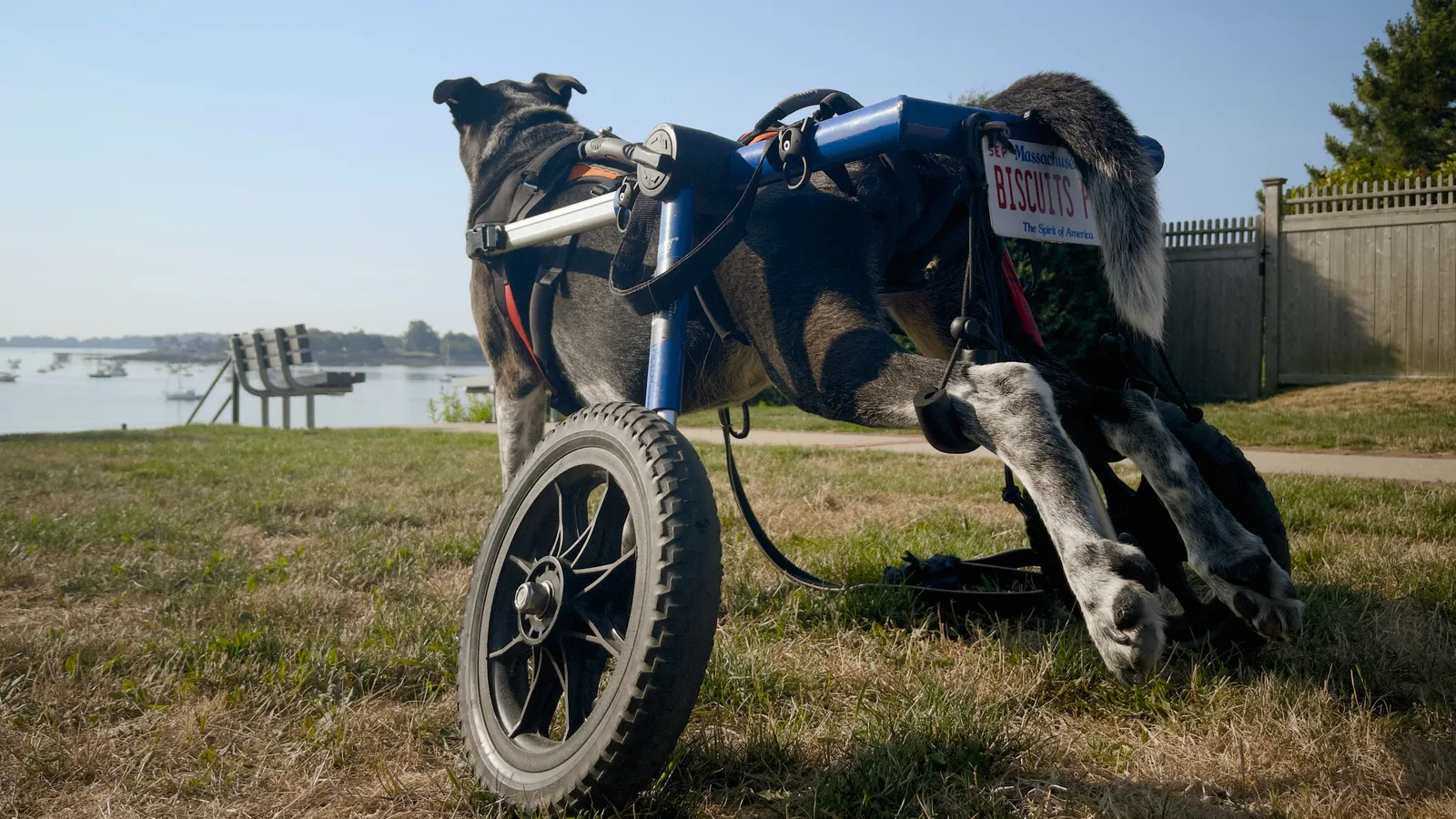
I got him his mobility cart before it fully needed it, as I wanted to give him some time to get used to it. For the first month or so, we’d do one walk a day with it. He took to it without complaint. Other dog owners would tell me about their experience with a previous dog and how they rejected the cart. Not Luke. He seemed to enjoy it.

The cart carried the weight of the back half of his body, distributing it to the wheels on either side of him. This allowed him to continue to walk with support. Because DM makes a dog lose proprioception, their paws start to curl into a loose “fist”, and they “knuckle”, meaning they walk with the paws curled up. Because of this, he still needed the boot when walking in the cart. He was happy to be able to keep going around town to go collect biscuits with relative ease. I even got a mini license plate for the cart that read BISCUITS PLZ.
The sight of this happy aged dog walking around town in a mobility cart attracted tons of attention. He would get a lot of sympathetic looks as we passed by. Many people wanted to stop and say hello to him. It was one of the most reliable conversation starters I’ve ever experienced, and I was happy to tell people about Luke and what was going on with him. A lot of people asked me if I had built the cart, presumably because they’re not a common sight, especially with a larger dog. Thanks to all the attention it garnered, I took to calling the cart his Sympathy Chariot.
I was never fishing for compliments in these interactions, but they came freely. A lot of people seem to think that most folks in my position wouldn’t want to deal with the inconvenience of caring for their pets in this way, which saddened me. Of course I would do it for Luke. Yes, his body was breaking down, but he was still happy and content, and I was able to give him the assistance he needed. There was never any question in my mind about “should I continue?” Not yet, anyway.
Before long, his left hind leg also started knuckling and scraping. So, another boot was in order for that paw. By that time he could barely walk at all without the support of the cart. A few more months passed, and he couldn’t really walk with his back legs with the support of the cart. He had started to drag them, so I slung them up in stirrups, first the right, then the left. The boots were no longer necessary. He was walking with just his front paws and the wheels. By this point, his hind legs were, for all intents and purposes, paralyzed. But still, he was happy and well adjusted through it all.
As the summer gave way to autumn, other things started breaking down. Because his back legs were now paralyzed, he could no longer stand. He couldn’t get up and go to his food and water bowls. He couldn’t scratch himself any more. He started having trouble just turning himself around in bed. Still, he tried to do all these things. He could still drag himself around the room using his front legs. His efforts gave him a solid upper body workout—he was kind of jacked for a bit there.
Throughout most of his life, Luke never had any bathroom accidents in the house. But as the DM was robbing him of his ability to feel what was going on in the back half of his body, he started to lose bowel control. While he did still sometimes do it when we were out on a walk, pooping in bed became the norm for him. I did sometimes wonder if he could still sort of control it, but because walks were getting harder, he found it easier to just let loose while lying in bed. By the beginning of 2026, urinary incontinence followed. Pee pads and diapers became regular accessories. He was still well adjusted, but struggling mightily. The aperture on his quality of life was closing shut.
Saying Goodbye
In the last few weeks, his front legs had gotten obviously weak. He could still use them, but they would soon shut down like his back legs did a year ago. While he would still reluctantly be game for them, walks had become a struggle. I didn’t want him to get to the point where his front legs also failed completely. It was time to say goodbye.
I scheduled a vet, a friend of friend, to euthanize him at home. When the day came, he was in bed, surrounded by people who love him. We were giving him love, giving him affection, and giving him lots of treats and goodies. He was happy. He was content to be there, sharing this moment with us. As the vet gave the injections, and he started to fade, there was no anxiety from him. He got drowsy, he stopped eating the treats, put his head down and drooled a little, taking in the last pets he could perceive. Within a few minutes, his heart had stopped beating. He was free. He would never have to suffer again.
Luke is not the first dog I’ve put down in my life, but his passing was the most peaceful of them. To have had ample time to think about the moment, and to be able to do it when it felt right to do so, rather than in an emergency, is huge.
Of course, I’m gutted that he’s gone, but I am at peace with it. It was a privilege to be his person, and my life is richer for him having been a part of it.

RIP Luke, c. May 20, 2014–March 3, 2026. You’ll always be The Goodest Boy.